
With the meCash API, you can connect international payments, currency conversion, and virtual accounts directly into your own systems — letting your business move money globally with ease.
This guide covers why integrating with meCash benefits your business, how the integration process works step-by-step, the key API components (quotes, payouts, virtual accounts, webhooks), best practices for developers, and real-world integration use cases.
Why Integrate with meCash?
Integrating directly with the meCash API unlocks a suite of strategic advantages. Global reach with local simplicity means sending and receiving payments in numerous currencies and countries through a single API and dashboard, eliminating the need to manage complex relationships with multiple local banks. Enhanced speed and cost efficiency comes from replacing outdated banking networks with streamlined cross-border rails, significantly reducing transaction times and operational costs.
The API features RESTful endpoints, comprehensive documentation, and a fully-featured sandbox environment for faster building and testing. The Quote API provides exact exchange rates and fees before transaction commitment, and webhook setup enables automated notifications when payouts complete or funds arrive, eliminating manual reconciliation.
Getting Started: Your Integration Roadmap
- Create your business account and complete KYB. Sign up for a meCash business account and complete Know Your Business verification for security and compliance.
- Access the developer dashboard and generate API keys. Once verified, generate unique keys for sandbox testing and production environments. Treat these keys like passwords and store them securely.
- Configure your sandbox environment. Use sandbox API keys to build and test your integration without using real funds.
- Whitelist your IPs. Whitelist server IP addresses to ensure only authorized systems interact with your account.
- Map your use case and design your workflow. Determine whether you’ll send payouts to vendors, collect payments via virtual accounts, or both, and identify the specific endpoints you need.
- Build and test in the sandbox. Simulate successful transactions, failures, and quote expirations.
- Go live. Switch from sandbox to production by swapping API keys, starting with small transaction volumes and gradually increasing as you monitor performance.
Key API Component: The Quotes API
The Quote API provides real-time exchange rates and fee breakdowns before initiating transfers, locking in prices to avoid market volatility.
Endpoint: POST /v1/quote
{
  "paymentChannel": "BANK_TRANSFER",
  "source": {
    "amount": 100000,
    "country": "NG",
    "currency": "NGN"
  },
  "target": {
    "country": "DK",
    "currency": "EUR"
  }
}
The API responds with a unique quote ID, source and target amounts, a locked-in exchange rate, applicable fees, and an expiration time.
Key API Component: The Payouts API
The Payout API enables sending funds efficiently across the globe, with routes including Nigeria (NGN to NGN, USD, GBP, EUR) and Malawi (MWK to MWK), each with its own limits and compliance requirements.
curl --location --globoff '{{baseURL}}/v1/quote' \
--header 'x-api-key: YOUR_API_KEY' \
--header 'Content-Type: application/json' \
--data '{
  "paymentChannel": "",
  "source": {
    "amount": 150000,
    "country": "NG",
    "currency": "NGN"
  },
  "target": {
    "country": "US",
    "currency": "USD"
  }
}'
Upon a successful request, the API returns a quote ID, status, and reference. Track transaction progress using webhooks.
Key API Component: The Virtual Accounts API
The Virtual Accounts API lets you generate unique, traceable bank accounts on demand for automating payment collections, simplifying reconciliation, or managing invoicing at scale.
Endpoint: POST /v1/virtual-account
Dynamic virtual accounts are temporary and expire after a set time — ideal for one-time or short-term transactions like invoice payments. Static virtual accounts are permanent and assigned to specific customers — best for recurring or long-term use cases like subscriptions. Each account is linked to your business wallet, and incoming payments trigger real-time webhook events.
For a subscription platform billing customers monthly across different countries, the flow looks like this: your backend calls the Virtual Accounts API to generate a unique account for each subscriber in their local currency, the subscriber pays through a standard bank transfer, meCash detects the transaction immediately, a virtualaccount.completed webhook fires notifying your system in real time, and your platform updates subscription status and credits the customer’s account — no manual intervention required.
Automate and React With Webhooks
Webhooks are automated messages sent from meCash to your system when events occur. Subscribe to critical events like payout.completed, collection.completed, virtualaccount.completed, and ramp.payout.completed to automate internal actions such as updating ledgers, sending customer receipts, or triggering downstream workflows.
Best Practices for a Secure and Robust Integration
Never expose API keys on the client side — store them securely on your server. Configure IP whitelisting so your account only accepts calls from approved server addresses. Test thoroughly in the sandbox to catch edge cases before going live. Log and monitor all API responses and incoming webhook events for debugging. Handle quote expirations gracefully by requesting new ones when needed, and lean on webhooks and virtual accounts to automate reconciliation rather than doing it by hand.
Summary
Integrating with the meCash API unlocks global payment access with locked-in rates, automates collections and payouts with real-time notifications, and enables scaling through one secure, modern platform. Whether paying international suppliers, collecting from a global customer base, or managing multi-currency wallets, meCash APIs provide a simple, fast, and reliable financial infrastructure foundation.
Related reading
How meCash Is Solving Africa's Payment Fragmentation with a Unified API
African businesses don't just have a payment problem, they have a fragmentation problem. A startup paying vendors in Kenya needs M-Pesa. Another wants salaries in Ghana via mobile money. Here's how one integration replaces the tangle.
The Asia-America-Africa Trade Triangle: Why Cross-Border Payments Are the Missing Link
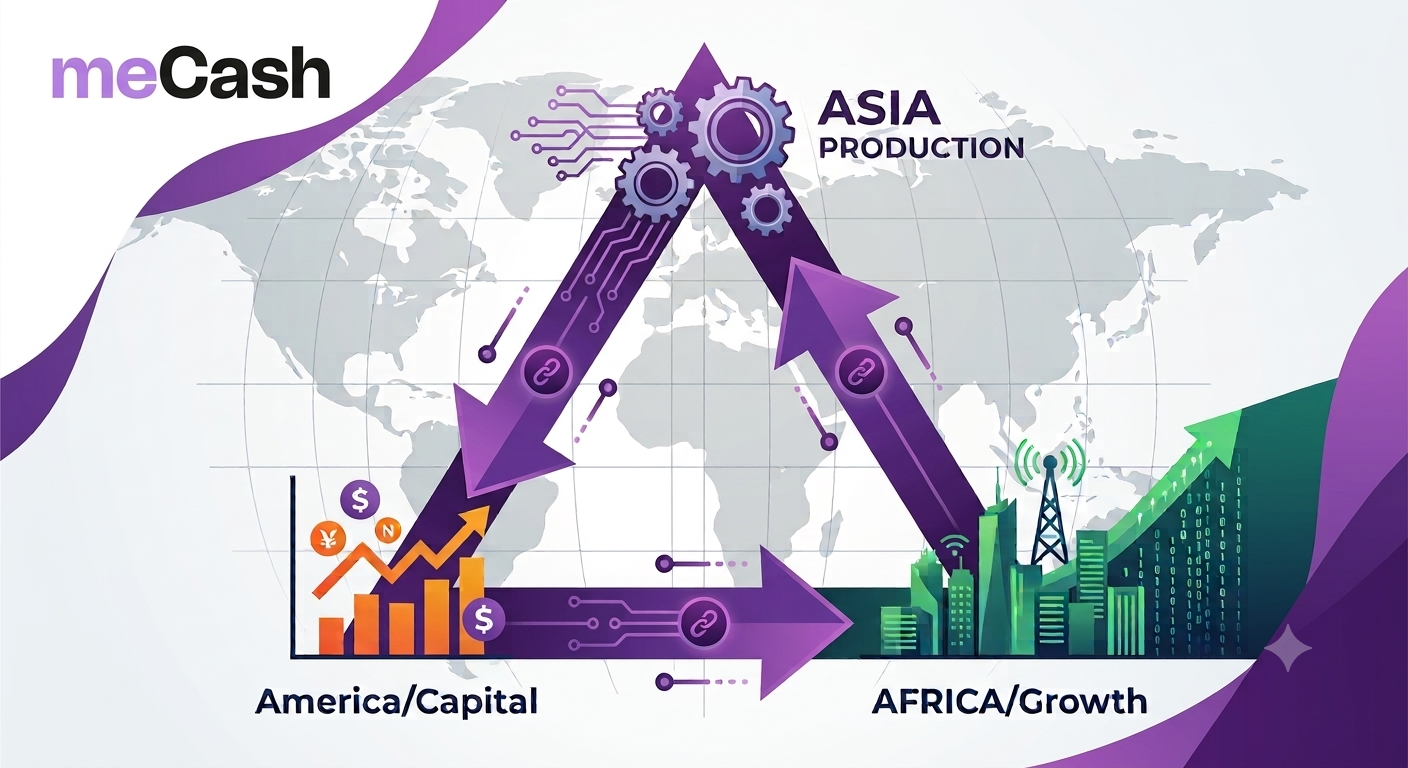
A component manufacturer in Shenzhen ships smartphone parts to Vietnam. A US brand pays in dollars. The finished phones sell in naira in Lagos. That single trade touches three financial systems before it closes — and that's where the friction hides.
meCash Bulk API: The Smarter Way to Handle Bulk Vendor and Customer Payment
What starts as a few manual bank transfers can quickly compound into thousands of transactions that must be processed accurately and on time. Here's the operational bottleneck meCash Bulk Payout was built to solve.
Subscribe to our newsletter
Get the latest insights on cross-border payments, API infrastructure, and fintech trends delivered to your inbox.