
If you are a business owner in Lagos, Lilongwe, Nairobi, or Kigali, you know the frustration of trading within Africa.
It is an irony of modern African business: it is often easier to pay a supplier in China or the US than it is to pay a partner just a few borders away. If you are holding Naira (NGN) and need to pay a supplier in Malawian Kwacha (MWK), or if you are a Kenyan business needing to settle an invoice in Rwanda (RWF), you are likely forced into the “Dollar Trap.”
You convert your local currency to USD (losing money), send it via a slow wire transfer (losing time), and your recipient converts it back to their local currency (losing money again).
The future of business wallets isn’t just about holding dollars; it’s about holding Africa. Here is how multi-currency accounts for MWK, NGN, KES, and RWF are changing the game.
The “Dollar Trap” in Intra-African Trade
For years, the US dollar has been the painfully expensive bridge between African currencies. Imagine a Nigerian logistics company paying a partner in Kenya. First, you sell NGN to buy USD, paying a high exchange rate. Then you wire the USD, paying SWIFT fees and waiting three to five days. Finally, your Kenyan partner receives USD and sells it to buy KES, paying another spread.
The result: you lose 5 to 15 percent of the transaction value to banks, just to move money across the continent.
The Solution: Direct Local Settlements
The new generation of business wallets — led by meCash — removes the middleman currency. By offering dedicated wallets for Malawian Kwacha, Nigerian Naira, Kenyan Shilling, and Rwandan Franc, you can finally trade directly.
A true multi-currency wallet lets you hold balances in all four at once. If you have revenue coming in from Rwanda, you don’t need to convert it immediately — you can hold that RWF in your wallet and use it to pay your next expense in Kigali. That’s a natural hedge that saves you the full cost of conversion fees.
It also means you can pay like a local, anywhere. When your wallet supports these specific corridors, you can pay a supplier in Malawi directly in MWK, or a partner in Kenya in KES. To them, it looks like a local bank transfer. It settles faster, and the fees are a fraction of international wire costs.
Product Spotlight: The meCash African Advantage
At meCash, we don’t just support global currencies; we specialize in African connectivity. We’ve built the infrastructure to make moving money between Nigeria, Malawi, Kenya, and Rwanda as easy as sending a text.
For businesses in Malawi, that means no more struggling with FX scarcity — you can receive MWK from local clients and settle international suppliers seamlessly. For Nigerian businesses, the heartbeat of African trade, it means paying partners in East Africa without sourcing scarce dollars first. For businesses in Kenya, whether a freelancer or a logistics firm, it means receiving KES instantly and converting to NGN or RWF only when the time is right. And for Rwandan businesses building in one of the continent’s growing innovation hubs, it means accepting payments from partners in West and East Africa directly into your RWF wallet, bypassing slow correspondent banks.
The Bottom Line
If your business operates across African borders, your bank account shouldn’t act like a border control checkpoint. Stop paying the dollar tax on every transaction. By using a wallet that natively understands MWK, NGN, KES, and RWF, you keep your profit where it belongs: in your business.
Related reading
The 5 Best Cross-Border Payment Solutions for Freelancers in 2025
A comparative review of popular platforms — meCash, Payoneer, PayPal, Stripe, and Revolut — focusing on low fees and ease of use for freelancers getting paid across borders.
How meCash Is Solving Africa's Payment Fragmentation with a Unified API
African businesses don't just have a payment problem, they have a fragmentation problem. A startup paying vendors in Kenya needs M-Pesa. Another wants salaries in Ghana via mobile money. Here's how one integration replaces the tangle.
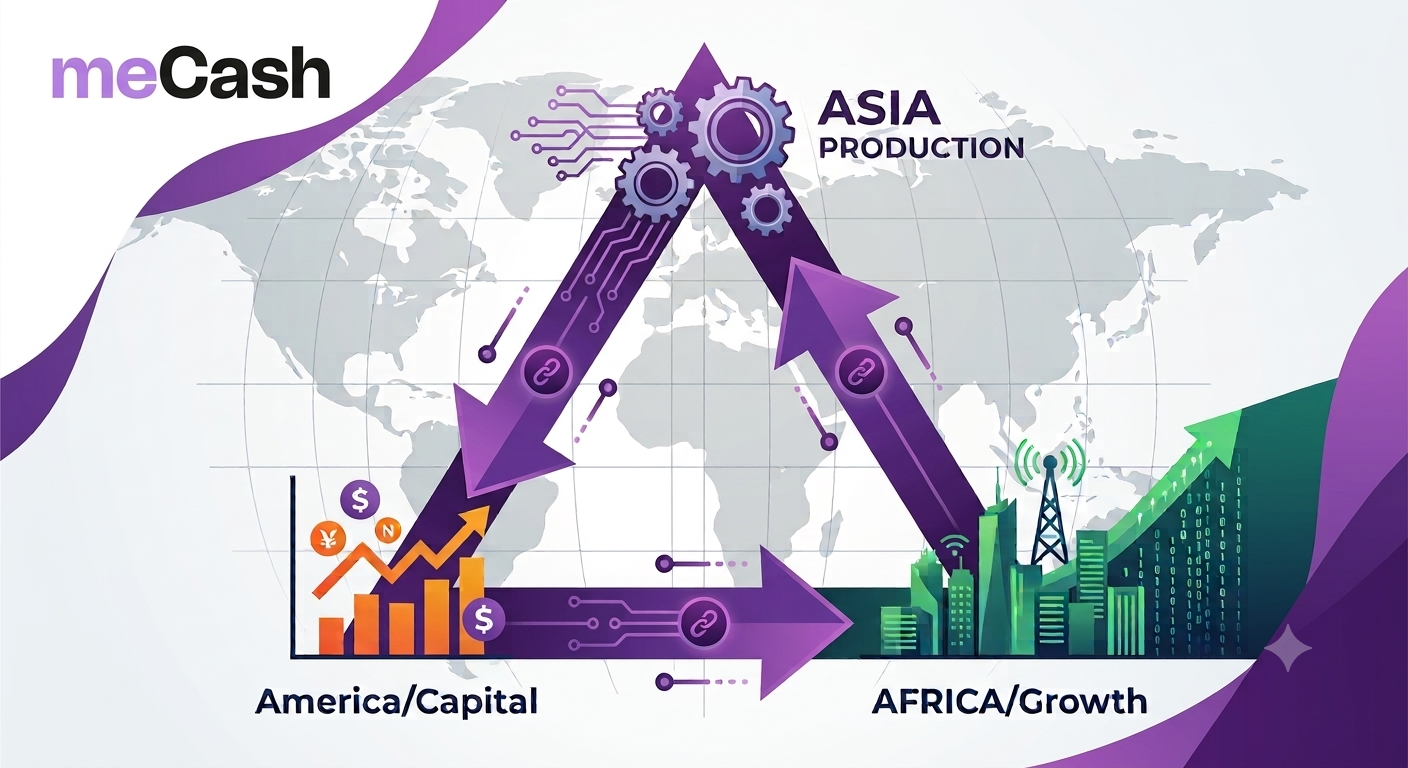
The Asia-America-Africa Trade Triangle: Why Cross-Border Payments Are the Missing Link
A component manufacturer in Shenzhen ships smartphone parts to Vietnam. A US brand pays in dollars. The finished phones sell in naira in Lagos. That single trade touches three financial systems before it closes — and that's where the friction hides.
Subscribe to our newsletter
Get the latest insights on cross-border payments, API infrastructure, and fintech trends delivered to your inbox.