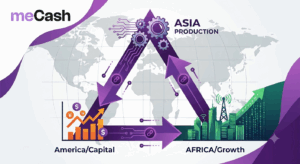

The global payments system is reorganising around one reality: money now follows trade, not banking infrastructure.
Asia sits at the center of that shift. Over the past decade, it has become the dominant hub for trade, manufacturing, and digital services, which has naturally pushed it into a leading position in global payment flows.
At the same time, Africa–Asia trade is expanding steadily across commodities, manufacturing, digital labour, and e-commerce.
But there is a gap.
Trade is scaling faster than the infrastructure that settles it.
The Problem: Trade Has Outgrown Payment Infrastructure
Even with rapid progress in digital payments Asia, the region remains structurally fragmented. Payments are fast domestically, but cross-border settlement is still complex. Transactions move through multiple intermediaries, FX layers, and banking systems that were not designed for today’s volume or frequency of flows.
This problem becomes more visible when Africa enters the system because on one hand, Africa–Asia trade has grown across three key areas:
- Chinese and Indian manufacturing exports into African markets
- African commodity exports into Asia
- Rising digital labour and service exports from Africa to Asia-based firms
But on the other hand, settlement remains slow, costly, and operationally heavy.
According to the World Bank, remittance costs and inefficiencies remain persistent in cross-border flows despite increasing volume growth globally.
The issue is not demand.
It is infrastructure alignment.
Africa–Asia Trade Flow: Growth Without Matching Rails
Africa–Asia trade is now one of the most active emerging global corridors, but it does not operate on a unified payment system. Instead, it relies on layered routing:
- African buyers paying Asian suppliers through multi-step FX paths
- Freelancers and service providers receiving cross-border payouts via intermediaries
- Trade payments routed through multiple jurisdictions before settlement
This introduces friction:
- FX exposure increases cost unpredictability
- settlement delays affect liquidity cycles
- reconciliation becomes manual
- operational overhead rises sharply
McKinsey has described Asia as one of the most dynamic fintech ecosystems globally, driven by mobile adoption and fragmented but rapidly digitising financial systems. The result is a system where trade is efficient at the commercial layer, but inefficient at the settlement layer.
Connecting Africa–Asia Trade Through meCash Payment Infrastructure
This is where the structure begins to shift from macroeconomics to infrastructure.
As Africa–Asia trade expands, the need for reliable, multi-country settlement systems becomes more important than individual payment methods.
The friction point is no longer trade itself. It is payout orchestration across multiple markets, currencies, and rails.
This is the layer where infrastructure providers like meCash become relevant.
The meCash payout API is built for a specific problem: moving money across fragmented markets and multiple countries without relying on manual processes.
At its core, the meCash payout API enables businesses to:
- trigger payouts programmatically via API
- send funds across multiple countries and currencies
- execute settlements through supported payout routes
- handle bank transfer and mobile money disbursements
- track transaction state through structured responses and webhooks
From the official payout flow, each transaction is processed through a structured lifecycle involving quote generation, payout execution, and webhook confirmation, ensuring visibility from initiation to settlement.
This matters in practice because Africa–Asia trade does not operate on a single rail. It operates across multiple Asia payment corridors, where settlement conditions differ by country, currency, and banking infrastructure.
The meCash payout API helps unify this fragmentation by abstracting payout execution into a single programmable layer.
Instead of building separate payout logic per market, platforms can:
- integrate once
- operate across multiple Asian countries
- extend payouts into cross-border corridors
- manage disbursements at scale without manual intervention
In effect, it reduces Africa–Asia trade settlement from a multi-system coordination problem into a single API-driven workflow.