A mobile money collection is a payment request sent directly to a customer’s mobile wallet, which the customer approves using their provider’s verification process. For businesses operating across Africa, a mobile money collection API like meCash’s lets you request, track, and confirm these payments programmatically, instead of relying on manual reconciliation or in-person cash handling.
This guide breaks down how mobile money collections actually work, why they’re different from simply sending money, and how the meCash Mobile Money Collections API fits into a business’s payment infrastructure.
What Is Mobile Money?
Mobile money is a financial service that lets users store, send, and receive money through an account linked to their mobile phone number, without necessarily needing a traditional bank account.
Unlike conventional banking, mobile money is accessible on both smartphones and basic feature phones. Users can send funds, pay for goods and services, buy airtime, and withdraw cash through a network of local agents. In markets like Nigeria, Kenya, Ghana, Uganda, and Rwanda, a mobile money wallet is often someone’s primary — sometimes only — point of contact with digital financial services. That reach is exactly why mobile money has become central to how businesses get paid across the continent.
Why Mobile Money Collection Matters for Businesses
Most conversations about mobile money focus on the consumer side: how fast can someone send funds, how convenient is it compared to cash. Those questions matter, but they’re not what a business actually needs answered.
A business needs a reliable way to collect payments from mobile wallets, confirm each transaction, and keep accurate records of what’s been paid. That gets harder once payments span multiple countries, currencies, or mobile money operators — which is the reality for almost any business operating beyond a single market in Africa. This is the point where mobile money stops being just a payment method customers use and becomes part of a company’s core payment infrastructure.
Mobile Money Collection vs. Sending Money: What’s the Difference?
Sending and collecting money look similar on the surface, but the mechanics are different.
When an individual sends money, they initiate and complete the transaction themselves. A business collecting payment usually can’t do that — it has to request payment from a customer and wait for that customer to approve the transaction from their own wallet. Once approved, the business still needs to know whether the payment succeeded, failed, or is still processing. Without the right tooling, tracking that across many customers and countries quickly turns into a manual, error-prone process.
How Mobile Money Collections Work
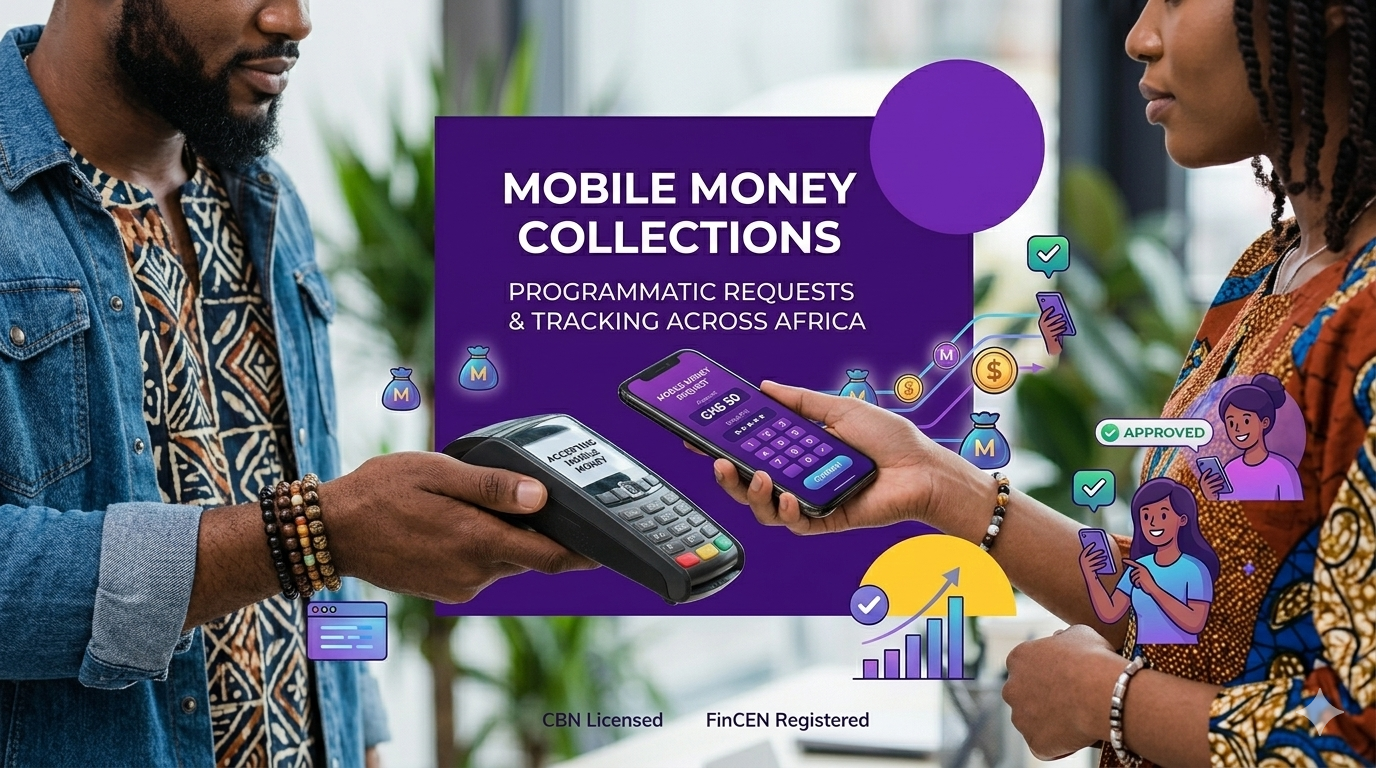
A mobile money collection is a payment request sent to a customer’s mobile wallet. The customer receives a prompt, reviews the request, and authorizes the payment using their provider’s verification process — typically a PIN. Once approved, the payment moves through the provider’s network and the transaction status updates accordingly.
For a business, the work isn’t done once the request is sent. The real question is visibility:
- Was the payment completed?
- Did the customer decline it?
- Is it still processing?
A mobile money collection API answers these questions automatically rather than leaving a business to guess.
How meCash Powers Mobile Money Collections
meCash provides a Mobile Money Collections API that lets businesses request and receive payments from supported mobile money wallets across Africa, alongside its Quote, Wallet, Payout, Transaction, and Virtual Account APIs for the rest of the payment lifecycle.
Here’s how a typical integration works:
- Identify supported operators. A business queries meCash for the mobile money operators available in a given country and currency.
- Initiate the collection. The business submits a collection request with the customer’s phone number, the amount, and the currency.
- Customer authorization. The customer receives a payment prompt on their device and approves it through their mobile money provider.
- Real-time status tracking. Instead of polling for updates, businesses receive webhook notifications as the transaction moves through each stage — initiated, processing, completed, or failed.
That webhook-driven visibility is what turns mobile money collection from a manual reconciliation task into an automated part of a payment workflow. meCash currently supports mobile money and bank transfer collections across 16+ African markets, including Nigeria, Kenya, Ghana, Rwanda, Uganda, and Zambia, with operations licensed by the Central Bank of Nigeria (CBN), the National Bank of Rwanda (BNR), and registered with FinCEN in the US.
Where Mobile Money Collections Are Useful
Mobile money collection supports a wide range of business models:
- E-commerce platforms that need a simple, trusted way for customers to pay for products without a card.
- Fintech applications that let users fund in-app wallets or accounts via mobile money.
- Marketplaces that need to collect from customers using different mobile money providers across several countries through one integration.
- Subscription and SaaS businesses collecting recurring payments from customers who don’t have card access.
In each case, the goal is the same: shrink the gap between a customer deciding to pay and the payment actually clearing — using a method customers already trust and already use daily.
Is Mobile Money Collection Secure?
Yes. Mobile money has earned trust with millions of users because of how transactions are authenticated and recorded. Providers require PIN verification before a transaction completes, and every transaction is logged electronically, creating a clear digital audit trail.
On the API side, meCash layers in licensing and regulatory compliance — operating under CBN, BNR, and FinCEN oversight — alongside webhook-based confirmation, so businesses aren’t relying on unverified or self-reported payment status. As with any financial transaction, customers should still protect their mobile money PIN and review payment requests carefully before approving them.
Frequently Asked Questions
What is a mobile money collection? A mobile money collection is a payment request sent to a customer’s mobile wallet. The customer reviews and authorizes the request through their mobile money provider, and the business receives confirmation once the payment is completed.
How do mobile money APIs work? A mobile money API lets a business request a payment from a customer’s wallet, then tracks that transaction through its lifecycle — initiated, processing, completed, or failed — typically via webhook notifications, instead of requiring the business to check status manually.
What’s the difference between mobile money and a bank transfer? Mobile money is tied to a phone number and a mobile wallet, accessible via smartphone or feature phone through local agents. A bank transfer requires a traditional bank account. In many African markets, mobile money has far broader reach than bank accounts, making it a primary payment method rather than an alternative one.
Is mobile money collection safe for businesses? Yes. Transactions require PIN-based authentication from the customer and are recorded electronically. Using a licensed, regulated provider like meCash adds an additional layer of compliance and verified transaction status.
Which countries does meCash support for mobile money collections? meCash supports mobile money and bank transfer collections across 16+ African countries, including Nigeria, Kenya, Ghana, Rwanda, Uganda, and Zambia.
Can I collect mobile money payments across multiple African countries with one API? Yes. The meCash Mobile Money Collections API is built to handle collections across multiple countries, currencies, and mobile money operators through a single integration, rather than requiring separate integrations per market.
How long does a mobile money collection take to process? Once a customer approves the payment request on their device, processing typically completes within seconds to a few minutes, depending on the mobile money provider’s network. meCash sends a webhook notification as soon as the status changes, so businesses don’t need to poll for updates.
Get Started
Mobile money isn’t a question of if your customers use it — in most African markets, they already do. The real question is whether your payment infrastructure can collect those payments reliably, confirm them automatically, and scale across borders without extra engineering overhead.
Explore the meCash Mobile Money Collections API documentation or contact our team to start integrating mobile money collection into your platform.