A component manufacturer in Shenzhen ships a container of smartphone parts to an assembly partner in Vietnam. A US consumer electronics brand places the order, wires payment in dollars, and takes ownership of the finished units. Six weeks later those phones are on a distributor’s shelf in Lagos, sold in naira, with a share of the proceeds owed back upstream in dollars to the US brand and, eventually, back to the Shenzhen supplier in yuan.
That single product touched three financial systems, four currencies, and at least two correspondent banking relationships before the trade closed. Nothing about the transaction was unusual. This is what modern trade looks like, and it’s also where most of the friction, delay, and cost quietly accumulates.
The three-region shift executives can’t ignore
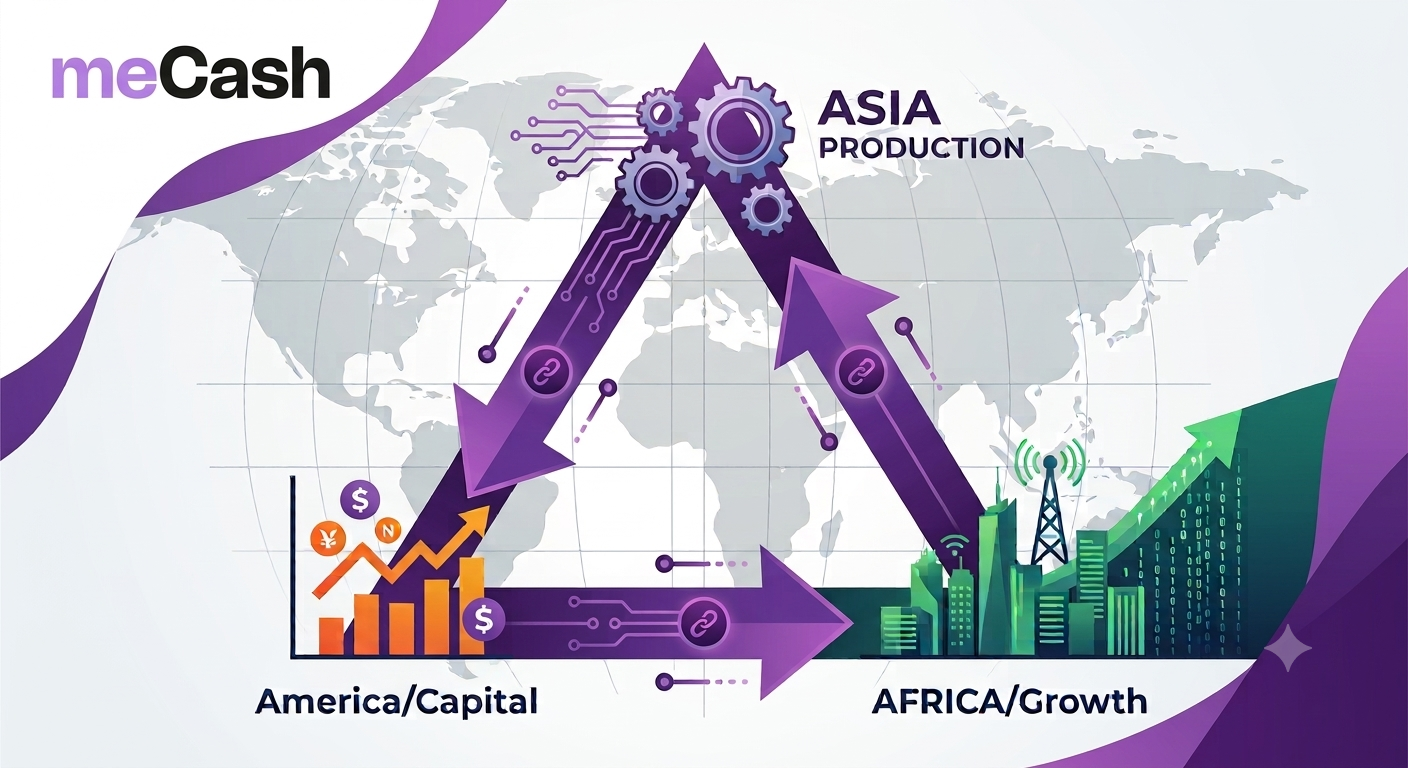
For the last two decades, global trade has mostly been read as a two-way story: Asia manufactures, the West consumes. That framing is now incomplete. A third region has entered the picture as both a destination for goods and a source of demand in its own right.
Asia is the production center. Component manufacturing, assembly, and industrial exports remain concentrated there, and the region’s trade relationship with Africa makes this concrete. China-Africa trade hit a record US$348 billion in 2025, a 17.7% annual increase, and the composition of that trade tells the real story: Chinese exports to Africa are dominated by manufactured and industrial goods such as machinery, electronics, vehicles, and light manufacturing which together account for almost 75% of what China ships to the continent, while its imports from Africa remain concentrated in raw materials like crude oil, copper, cobalt, and iron ore.
America is the commerce center. Wall Street and Nasdaq remain the deepest pools of capital on earth, and most of the world’s largest companies by market value are listed there. That concentration of capital markets means American investors, lenders, and public companies are frequently the ones underwriting global trade in the first place.
Africa is the emerging market both of them need. Africa’s digital payments market is projected to exceed $40 billion by 2026. Regional fintech is the fastest-growing sector of its kind globally, with revenues projected to expand 13-fold to roughly $65 billion by 2030. That growth is exactly why Asian manufacturers and American brands are paying closer attention to African distribution, and why getting paid reliably, and in a currency that’s usable has become a real strategic question, not an afterthought.
How can businesses pay into Africa from Asia or the US?
The short answer: through a payment partner with local settlement infrastructure in African markets, rather than through the traditional correspondent banking chain. A business in Shenzhen or New York can send funds via a fintech that holds virtual accounts and direct banking relationships across African countries, converts to local currency at the point of settlement, and pays the recipient in hours instead of days, without the payment bouncing through three or four intermediary banks first.
Where the friction actually sits
The obstacle was never really the trade itself, tt’s the money that’s supposed to follow it, and it gets stuck in two places.
The inbound leg is the first problem. A payment from Shenzhen or New York into Lagos or Nairobi would be routed through correspondent banks in hubs like New York or London, each intermediary taking a cut and adding delay. Cross-border payment fees into Africa average 6% to 10% and settlement can stretch to several days.
The second problem is worse: payments between African countries. A payment from Nairobi to Lagos often routes back out through a foreign intermediary before coming back in, instead of settling directly, 88% of intra-African transactions still work this way. That’s a direct cause of intra-African trade sitting below 20 percent of the continent’s total trade, versus over 60 percent in Europe.
Regional efforts like the Pan-African Payment and Settlement System are addressing this by letting traders settle in local currencies instead of the US dollar, but adoption remains uneven, and every market still carries its own licensing and compliance regime.
For a manufacturer in Asia or a buyer in the US, none of this shows up until the money is already stuck. A shipment clears, an invoice is issued, and then payment sits in transit for days while FX volatility eats into the margin both sides agreed on
Where meCash fits into the corridor
This is the specific gap meCash is built to close: payment infrastructure for money moving into Africa from Asia and the US, and across African markets once it’s there, with reach into 150+ countries overall. Five building blocks map directly onto the friction above.
Payment Links — generates a shareable checkout link for a one-off or recurring invoice, so a Shenzhen manufacturer or US buyer can get paid without either side needing a formal integration to start.
Virtual Account API — generates a static or dynamic virtual account in the destination market, so a distributor in Lagos or Nairobi can collect payment as if they held a local bank account, without the sender needing one too.
Payout API — sends funds to a bank account or straight to a mobile money wallet, since mobile money, not a bank account, is often how local suppliers and distributors actually get paid.
Quote API — returns a guaranteed exchange rate and fee upfront, corridor by corridor, so FX cost is known before the money moves rather than discovered after.
Wallet API — holds multi-currency balances and pairs with webhook events on payouts, collections, and virtual accounts, so reconciliation across currencies happens automatically.
meCash also holds an IMTO license in Nigeria, a PSP license in Rwanda, and MSB registrations in the US and Canada — regulatory groundwork a manufacturer or buyer would otherwise have to evaluate market by market alone.
The same infrastructure covers the leg that’s easy to overlook: payment across Africa, not just into it. A payment from Nairobi to Lagos faces the same correspondent-banking detour as one from New York — meCash’s virtual accounts and payouts make that corridor as direct as the inbound one.
What payments infrastructure doesn’t solve
It’s worth being honest about the limits here. Fixing the payment rail doesn’t remove the need for local distribution partnerships, in-country regulatory registration, or the physical logistics of getting goods from a port to a shelf. Trade credit terms, customs clearance, and local market knowledge still matter as much as they ever did. Payment infrastructure removes one specific bottleneck — money getting stuck or losing value in transit — and that bottleneck happens to be one of the most expensive and least visible ones, but it’s one piece of a larger operation, not a substitute for the rest of it.
The takeaway for executives
The businesses that will benefit most from Africa’s growth aren’t necessarily the ones with the biggest trade volumes already flowing through China or the US. They’re the ones building payment relationships into African markets now, before volume forces the issue. Treating cross-border settlement in Africa as core infrastructure the same way a company would treat its shipping logistics or its supplier contracts, is what separates a business that can scale into the continent from one that gets stuck re-solving the same payment friction on every new deal.
efficiently — that’s the layer meCash addresses.
Ready to move money into and across African markets? Explore meCash’s API documentation at developer.me-cash.com.